The.Hottest

Kamal I. M. Al-Malah ... 592 pages - Language: ‎English - Publisher: ‎Wiley; (October, 2023).

Machine and Deep Learning Using MATLAB introduces early career professionals to the power of MATLAB to explore machine and deep learning applications by explaining the relevant MATLAB tool or app and how it is used for a given method or a collection of methods. Its properties, in terms of input and output arguments, are explained, the limitations or applicability is indicated via an accompanied text or a table, and a complete running example is shown with all needed MATLAB command prompt code. The text also presents the results, in the form of figures or tables, in parallel with the given MATLAB code, and the MATLAB written code can be later used as a template for trying to solve new cases or datasets. Throughout, the text features worked examples in each chapter for self-study with an accompanying website providing solutions and coding samples. Highlighted notes draw the attention of the user to critical points or issues.

Readers will also find information on: Numeric data acquisition and analysis in the form of applying computational algorithms to predict the numeric data patterns (clustering or unsupervised learning) + Relationships between predictors and response variable (supervised), categorically sub-divided into classification (discrete response) and regression (continuous response) + Image acquisition and analysis in the form of applying one of neural networks, and estimating net accuracy, net loss, and/or RMSE for the successive training, validation, and testing steps + Retraining and creation for image labeling, object identification, regression classification, and text recognition. Machine and Deep Learning Using MATLAB is a useful and highly comprehensive resource on the subject for professionals, advanced students, and researchers who have some familiarity with MATLAB and are situated in engineering and scientific fields, who wish to gain mastery over the software and its numerous applications.

Holly Moore ... 705 pages - Language: English - Publisher: Pearson; 6th edition (February, 2022).


MATLAB For Engineers starts at the beginning to introduce first-year engineering students to MATLAB. Starting with basic algebra, you'll learn how MATLAB can be used to solve a wide range of engineering problems. Examples taken from concepts presented in early chemistry, physics, and first- and second-year engineering classes are included. When the text covers new subjects, like statistics and matrix algebra, brief background information is used to support your success. As you work through hands-on examples and exercises, you'll learn to apply a consistent problem-solving methodology to help you reach a solution.

The 6th Edition reflects the MATLAB software release R2021B. Updated screenshots, new data, new problems and discussions offer a current view of the coding language and platform you'll use in your classes and career.

Graham Barnes ... 584 pages - Language: English - Publisher: ‎Bloomsbury Academic; 4th edition (June, 2016).

Now in its fourth edition, this popular textbook provides students with a clear understanding of the nature of soil and its behaviour, offering an insight into the application of principles to engineering solutions. It clearly relates theory to practice using a wide-range of case studies, and dozens of worked examples to show students how to tackle specific problems. A comprehensive companion website offers worked solutions to the exercises in the book, video interviews with practising engineers and a lecturer testbank.With its comprehensive coverage and accessible writing style, this book is ideal for students of all levels on courses in geotechnical engineering, civil engineering, highway engineering, environmental engineering and environmental management, and is also a handy guide for practitioners.

New to this Edition: - Brand-new case studies from around the world, demonstrating real-life situations and solutions - Over 100 worked examples, giving an insight into how engineers tackle specific problems - A companion website providing an integrated series of video interviews with practising engineers - An extensive online testbank of questions for lecturers to use alongside the book.

P. Purushothama Raj ... 1307 pages - Language: English - Publisher: ‎Pearson; 2nd edition (July, 2013). 

Soil Mechanics and Foundation Engineering, 2nd edition presents the principles of soil mechanics and foundation engineering in a simplified yet logical manner that assumes no prior knowledge of the subject. It includes all the relevant content required for a sound background in the subject, reinforcing theoretical aspects with comprehensive practical applications.

Ian Smith ...
456 pages - Language: English - Publisher: Wiley-BlackWell; 9th edition (September, 2014).


The 9th edition maintains the content on all soil mechanics subject areas - groundwater flow, soil physical properties, stresses, shear strength, consolidation and settlement, slope stability, retaining walls, shallow and deep foundations, highways, site investigation - but has been expanded to include a detailed explanation of how to use Eurocode 7 for geotechnical design.

The key change in this new edition is the expansion of the content covering Geotechnical Design to Eurocode 7. Redundant material relating to the now defunct British Standards - no longer referred to in degree teaching - has been removed. Building on the success of the earlier editions, this 9th edition of Smith’s Elements of Soil Mechanics brings additional material on geotechnical design to Eurocode 7 in an understandable format. Many worked examples are included to illustrate the processes for performing design to this European standard. Significant updates throughout the book have been made to reflect other developments in procedures and practices in the construction and site investigation industries. More worked examples and many new figures have been provided throughout. The illustrations have been improved and the new design and layout of the pages give a lift.

Michael Carter, Stephen P. Bentley ... 256 pages - Language: English - Publisher: Wiley; 2nd edition (September, 2016).


Soil Properties and their Correlations, Second Edition provides a summary of commonly-used soil engineering properties and gives a wide range of correlations between the various properties, presented in the context of how they will be used in geotechnical design. The book is divided into 11 chapters: Commonly-measured properties; Grading and plasticity; Density; Permeability, Consolidation and settlement; Shear strength; California bearing ratio; Shrinkage and swelling characteristics; Frost susceptibility; Susceptibility to combustion; and Soil-structure interfaces. In addition, there are two appendices: Soil classification systems; and Sampling methods.

This new, more comprehensive, edition provides material that would be of practical assistance to those faced with the problem of having to estimate soil behaviour from little or no laboratory test data. Key features: Soil properties explained in practical terms. + A large number of correlations between different soil properties. + A valuable aid for assessing design values of properties. + Clear statements on practical limitations and accuracy.

An invaluable source of reference for experienced professionals working on geotechnical design, it will also give students and early-career engineers an in-depth appreciation of the appropriate use of each property and the pitfalls to avoid.

Jay Ameratunga, Nagaratnam Sivakugan, Braja M. Das ... 400 pages - Language: English - Publisher: Springer; (December, 2015).


This book presents a one-stop reference to the empirical correlations used extensively in geotechnical engineering. Empirical correlations play a key role in geotechnical engineering designs and analysis. Laboratory and in situ testing of soils can add significant cost to a civil engineering project. By using appropriate empirical correlations, it is possible to derive many design parameters, thus limiting our reliance on these soil tests. The authors have decades of experience in geotechnical engineering, as professional engineers or researchers. The objective of this book is to present a critical evaluation of a wide range of empirical correlations reported in the literature, along with typical values of soil parameters, in the light of their experience and knowledge. This book will be a one-stop-shop for the practising professionals, geotechnical researchers and academics looking for specific correlations for estimating certain geotechnical parameters. The empirical correlations in the forms of equations and charts and typical values are collated from extensive literature review, and from the authors' database.

Bentley Seequent PLAXIS 2D and 3D Ultimate 2024.2.0.1144 [Size: 4.01 GB] ... 
PLAXIS 2D is a user-friendly, finite-element package that provides you with the ability to model diverse geotechnical problems from a single, integrated application. You can analyze the deformation and stability of projects ranging from excavations, embankments, and foundations to tunneling, mining, and geomechanics.

Complex 2D Geotechnical Analysis: Use the industry standard of limit equilibrium and finite element software for geotechnical analysis and benefit from innovative and state-of-the-art modeling capabilities. Geotechnical Information Integration: Integrate OpenGround data, topography, and engineered constructions using PLAXIS Designer's conceptual modeling tools and increase your efficiency in preparing 2D and 3D analysis models. Conduct Dynamic Analysis: Conduct dynamic analysis to analyze the effects of man-made or natural seismic vibration in soil or structures. Access Fully Coupled Flow-deformation Analysis: Assess the impact of precipitation or seasonal variations of water level on factor of safety through fully coupled flow-deformation analysis. More Efficiency within Software: Gain a competitive edge and rely on automated model build-up, results extraction, and reporting with command line or Python scripting.

PLAXIS 3D is a user-friendly, finite element package with trusted computation that is used by geotechnical engineers globally. PLAXIS 3D offers CAD-like drawing capabilities to help with the analysis of subsurface environments for geoengineering projects. From excavations, embankments, foundations, tunneling, and mining, to reservoir geomechanics, users can determine the deformation and stability of geotechnical engineering and rock mechanics to assess the geotechnical risk.

Reliably solve infrastructure challenges: Easily generate and scale construction sequences for excavations of any complexity. Facilitate steady-state groundwater flow calculations, including flow-related material parameters, boundary conditions, drains, and wells. Use interfaces and embedded pile elements to model movement between soil and foundation, such as slipping and gapping. Get trustworthy results with realistic soil models and a complete portfolio of visualization abilities. Create FE models quickly and efficiently: This comprehensive solution for the design and analysis of soils, rocks, and associated structures makes it easy to model in full 3D. Drawing tools, such as extrude, intersect, combine, and array operations facilitate finite element modeling, while multicore calculations and a 64-bit kernel can handle simple and complex models. Create safer infrastructures with fully-optimized designs. Get realistic assessments of stresses and displacement: To meet the unique geotechnical challenges of soil structure interactions, PLAXIS 3D offers different calculation types, such as plastic, consolidation, and safety analysis. A range of material models for predicting the behavior of various soils and rock types, combined with robust calculations, helps ensure reliable results. Display these forces in various ways, and use cross-section applications to inspect certain areas in greater detail. Drive efficiency with multidiscipline workflows: Create logical geotechnical digital workflows that take projects from subsurface imports through design and analysis to various outputs.

Bentley Seequent GeoStudio 2024.2.1 [Size: 911 MB] ... 
GeoStudio is a product suite for geotechnical and geo-environmental modeling, broad enough to handle all your modeling needs. The suite consists of 8 products: SLOPE/W for slope stability; SEEP/W for groundwater seepage; SIGMA/W for stress-deformation; QUAKE/W for dynamic earthquake; TEMP/W for geothermal; CTRAN/W for contaminant transport; AIR/W for air flow; VADOSE/W for vadose zone & covers.

GeoStudio 2D (SLOPE/W) offers the foundational capability to perform Limit Equilibrium slope stability analysis for soil and rock. GeoStudio 2D offers a comprehensive list of features, including: Rigorous formulation of limit equilibria. + 13 analysis methods, including Morgenstern-Price and Spencer. + Various slip surface search techniques including Entry-Exit, Grid and Radius, and Cuckoo. + Rigorous algorithm for solving nonlinear equations to calculate the safety coefficient. + Definition of pore water pressure with piezometric lines, spatial functions, Ru and B-bar. + Probabilistic and sensitivity analysis capabilities. + Partial factor, staged pseudostatic, and staged rapid decay formulations. + Complete library of material models for soil and rock. + Functions of reinforcement, overload and earthquake loads. + Supplier reinforcements library with products from Huesker, Maccaferri, TenCate and Tensar. + Limit state design support according to the Eurocode or for design by load resistance coefficients.

GeoStudio 2D Ultimate (SLOPE/W + SEEP/W + SIGMA/W + QUAKE/W) expands the capability of the GeoStudio 2D with functionality to deal with the most challenging geotechnical projects. It includes features to analyse static and dynamic stress and deformation within soil or rock, coupled consolidation, and finite element stability methods.

Joseph E. Bowles ... 1024 pages - Language: English - Publisher: McGraw-Hill; 5th Edition (September, 1995).


The revision of this best-selling text for a junior/senior course in Foundation Analysis and Design now includes an IBM computer disk containing 16 compiled programs together with the data sets used to produce the output sheets, as well as new material on sloping ground, pile and pile group analysis, and procedures for an improved anlysis of lateral piles. Bearing capacity analysis has been substantially revised for footings with horizontal as well as vertical loads. Footing design for overturning now incorporates the use of the same uniform linear pressure concept used in ascertaining the bearing capacity. Increased emphasis is placed on geotextiles for retaining walls and soil nailing.

MATLAB R2024b v24.2.0.2712019 x64 [Size: 12.530 GB] ... MATLAB is a high-performance language for technical computing. It integrates computation, visualization, and programming in an easy-to-use environment where problems and solutions are expressed in familiar mathematical notation.
 
Typical uses include: Math and computation + Algorithm development + Modeling, simulation, and prototyping + Data analysis, exploration, and visualization + Scientific and engineering graphics + Application development, including + Graphical User Interface building. MATLAB is an interactive system whose basic data element is an array that does not require dimensioning. This allows you to solve many technical computing problems, especially those with matrix and vector formulations, in a fraction of the time it would take to write a program in a scalar noninteractive language such as C or Fortran. The name MATLAB stands for matrix laboratory. MATLAB was originally written to provide easy access to matrix software developed by the LINPACK and EISPACK projects, which together represent the state-of-the-art in software for matrix computation. 

MATLAB has evolved over a period of years with input from many users. In university environments, it is the standard instructional tool for introductory and advanced courses in mathematics, engineering, and science. In industry, MATLAB is the tool of choice for high-productivity research, development, and analysis. MATLAB features a family of application-specific solutions called toolboxes. Very important to most users of MATLAB, toolboxes allow you to learn and apply specialized technology. Toolboxes are comprehensive collections of MATLAB functions (M-files) that extend the MATLAB environment to solve particular classes of problems. Areas in which toolboxes are available include signal processing, control systems, neural networks, fuzzy logic, wavelets, simulation, and many others.

The basic unit of this type of clay is formed by atomic bond of the unsatisfied face of silica sheet and either face of aluminum sheet as seen in Figure 1.

Figure 1. Kaolinite clay formation
The bond between two sheets is strong and, also, it is the primary bond. However, the stack of two sheets (with thickness 7.2 Ã… [Angstrom]) is not a form of clay yet. Many layers of this basic kaolinite unit make a kaolinite clay particle. Figure 3.3 shows an electron photomicrograph of well-crystallized kaolinite clay particles.

Figure 2. Electron photomicrograph of kaolinite clay
From the picture, it can be estimated that the diameter of a particle is about 5 μm, and the thickness of the particle is about one-tenth of that (i.e., 0.5 μm). Thus, it is required to have about 700 layers of the basic unit to make a kaolinite clay particle in the picture. The bond between each basic silica and aluminum sheet unit is the one between exposed OH- and satisfied O2- and is called a hydrogen bond. This bond is not as strong as the previous atomic bond (primary bond) but much stronger than the bond between exposed O2- and O2- in case of montmorillonite clay, which will be discussed later. Hydrogen bond is categorized as a primary bond in many literatures, but it shall be noted that this is a marginally strong bond. Because of its nature of bonds within the kaolinite particle, this clay is rather stable, has less swelling and shrinking characteristics, and is less problematic.

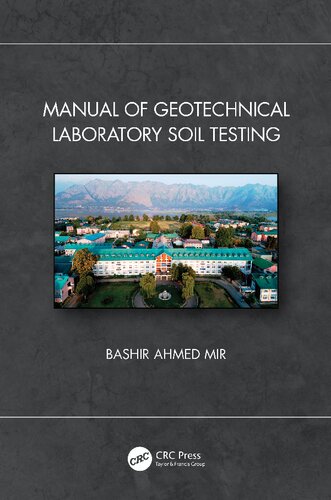
Bashir Ahmed Mir
... 663 pages - Language: English - Publisher: ‎CRC Press; (October, 2021).


Manual of Geotechnical Laboratory Soil Testing covers the physical, index, and engineering properties of soils, including compaction characteristics (optimum moisture content), permeability (coefficient of hydraulic conductivity), compressibility characteristics, and shear strength (cohesion intercept and angle of internal friction). Further, this manual covers data collection, analysis, computations, additional considerations, sources of error, precautionary measures, and the presentation results along with well-defined illustrations for each of the listed tests. Each test is based on relevant standards with pertinent references, broadly aimed at geotechnical design applications.

Features: Provides fundamental coverage of elementary-level laboratory characterization of soils + Describes objectives, basic concepts, general understanding, and appreciation of the geotechnical principles for determination of physical, index, and engineering properties of soil materials + Presents the step-by-step procedures for various tests based on relevant standards + Interprets soil analytical data and illustrates empirical relationship between various soil properties + Includes observation data sheet and analysis, results and discussions, and applications of test results + This manual is aimed at undergraduates, senior undergraduates, and researchers in geotechnical and civil engineering.

The water content w, also called the moisture content, is defined as the ratio of weight of water Ww to the weight of solids (Ws or Wd) in a given mass of soil.

Equation 1. Natural water content expressed by weights
The water content is generally expressed as a percentage. However, when used in the formulae giving relationship between certain quantities, it may also be expressed as a fraction. Rewriting Eq. 1, we have Eq. 2.

Equation 2. Water content as a fraction
The usual procedure to find the natural water content is to take a mass of about 20 g to 30 g of soil sample in a container and determine its mass M very accurately. The soil sample is then kept in an oven (105°C–110°C) for about 24 hours so that it becomes perfectly dry. Its dry mass Md is then determined and the water content is calculated from the relation,

Equation 3. Natural water content expressed by masses

Clay
needs special attention because of its small particle size. As discussed in the grain size distribution section, soils with their particle diameters less than 5 μm (2 μm in some classification systems) are classified as clay or clay-size particles. In such a small size, electrical interactive forces become more significant as compared to the physical frictional interactive forces in the case of larger grain soils (sand and gravel).

To understand various unique engineering behaviors of clay, it is most beneficial to study microstructures of clay particles first. The microstructural observation greatly helps to understand macrobehavior.

Figure 1.  Silica and aluminum sheets
In nature, basically there are three types of clay minerals-namely, kaolinite clay, illite clay, and montmorillonite clay. These clays have different atomic structures and behave differently and are all made of two basic atomic sheets- namely, silica tetrahedral sheets and aluminum octahedron sheets, as seen in Figure 1. Naturally abundant atom silica (Si) and aluminum atom (Al) occupy the center positions of the sheets, and oxygen atom (O2-) and hydroxyl (OH-) are strongly bonded to those core atoms, respectively. These bonds are either ionic or covalent, and actual bonds in silica and aluminum sheets are combinations of these two types of bonds.

Note that the ionic bond is due to exchange of orbiting electrons of two atoms such as Na+ (sodium ion) and Cl- (chlorine ion) to make NaCl (sodium chloride = salt), and the covalent bond is due to sharing electrons in their orbits such as two H+ (hydrogen ions) to form H2 (hydrogen gas). These atomic bonds are very strong and can never be broken by ordinary physical forces. They are called the primary bonds.

A silica tetrahedral sheet is symbolized with a trapezoid, of which the shorter face holds electrically unsatisfied oxygen atoms and the longer face holds electrically satisfied oxygen atoms. An aluminum octahedron sheet is symbolized with a rectangle with top and bottom faces having the same characteristics of exposed hydroxyl (OH-).

In most instances in nature, sheets are further bonded together, basically due to the unsatisfied face of a silica sheet to form various clay minerals.

Specific gravity G (or Gs)
is defined as the ratio of the weight of a given volume of soil solids at a given temperature to the weight of an equal volume of distilled water at that temperature, both weights being taken in air. In other words, it is the ratio of the unit weight of soil solids to that of water.

Equation 1: G = γs/γw

γw is the unit weight of water and is 9.81 kN/m3 or 62.4 lb/ft3. The Geotechnical Standard specifies 20°C as the standard temperature for reporting the specific gravity.

Some qualifying words like: true, absolute, apparent, bulk or mass, etc., are sometimes added to the term ‘specific gravity’. These qualifying words modify the sense of specific gravity as to whether it refers to soil particles or to soil mass. The soil solids have permeable and impermeable voids inside them, the permeable voids being capable of getting filled with water. If all the internal voids of soil particles (permeable and impermeable) are excluded for determining the true volume of solids, the specific gravity obtained is called absolute or true specific gravity. The apparent or mass or bulk specific gravity Gm denotes the specific gravity of soil mass and is given by

Equation 2: Gm = γ/γw

Unless otherwise specified, we shall denote the Specific Gravity G (or Gs) (defined by Eq. 1) as the specific gravity of soil solids. Table 1 gives the values of specific gravity of some important soil constituents.

Table 1. Specific gravity of soil constituents
Most soils have a rather narrow range of Gs values: 2.65 to 2.70. This implies that solid particle is about 2.65 to 2.70 times heavier than the weight of water for the same volume. If a specific gravity test was not performed during the initial evaluation of geotechnical engineering problems, assuming Gs as a value between 2.65 or 2.70 would not produce a major error in the results.

Rounding off a number is necessary so that the accuracy of the result will be the same as that of the problem data. As a general rule, any numerical figure ending in a number greater than five is rounded up and a number less than five is not rounded up. The rules for rounding off numbers are best illustrated by examples. 

Suppose the number 3.5587 is to be rounded off to three significant figures. Because the fourth digit (8) is greater than 5, the third number is rounded up to 3.56. Likewise 0.5896 becomes 0.590 and 9.3866 becomes 9.39. If we round off 1.341 to three significant figures, because the fourth digit (1) is less than 5, then we get 1.34. Likewise 0.3762 becomes 0.376 and 9.871 becomes 9.87. 

There is a special case for any number that ends in a 5. As a general rule, if the digit preceding the 5 is an even number, then this digit is not rounded up. If the digit preceding the 5 is an odd number, then it is rounded up. For example, 75.25 rounded off to three significant digits becomes 75.2, 0.1275 becomes 0.128, and 0.2555 becomes 0.256.

William Navidi ... 960 pages - Language: ‎ English - Publisher: ‎ McGraw-Hill; 6th Edition (January, 2023).

Statistics for Engineers and Scientists stands out for its clear presentation of applied statistics. The book takes a practical approach to methods of statistical modeling and data analysis that are most often used in scientific work. This edition features a unique approach highlighted by an engaging writing style that explains difficult concepts clearly, along with the use of contemporary real world data sets, to help motivate students and show direct connections to industry and research. While focusing on practical applications of statistics, the text makes extensive use of examples to motivate fundamental concepts and to develop intuition.

Table of Contents: Chapter 1: Sampling and Descriptive Statistics - Chapter 2: Probability - Chapter 3: Propagation of Error - Chapter 4: Commonly Used Distributions - Chapter 5: Confidence Intervals - Chapter 6: Hypothesis Testing - Chapter 7: Correlation and Simple Linear Regression - Chapter 8: Multiple Regression - Chapter 9: Factorial Experiments - Chapter 10: Statistical Quality Control.

The four basic quantities -length, time, mass, and force- are not all independent from one another; in fact, they are related by Newton’s second law of motion, F = ma. Because of this, the units used to measure these quantities cannot all be selected arbitrarily. The equality F = ma is maintained only if three of the four units, called base units, are defined and the fourth unit is then derived from the equation.

The International System of units, abbreviated SI after the French Système International d’Unités, is a modern version of the metric system which has received worldwide recognition. As shown in Table 1, the system defines length in meters (m), time in seconds (s), and mass in kilograms (kg). The unit of force, called a newton (N), is derived from F = ma. Thus, 1 newton is equal to a force required to give 1 kilogram of mass an acceleration of 1 m/s2 (N = kg.m/s2). Think of this force as the weight of a small apple.

If the weight of a body located at the “standard location” is to be determined in newtons, then W = mg must be applied. Here measurements give g = 9.80665 m/s2; however, for calculations, the value g = 9.81 m/s2 will be used. Therefore, a body of mass 1 kg has a weight of 9.81 N, a 2-kg body weighs 19.62 N, and so on, Fig. 1.

Table 1. International System of Units
Prefixes: When a numerical quantity is either very large or very small, the SI units used to define its size may be modified by using a prefix. Some of these prefixes used are shown in Table 2. Each represents a multiple or submultiple of a unit which, if applied successively, moves the decimal point of a numerical quantity to every third place. For example, 4 000 000 N = 4 000 kN (kilo-newton) = 4 MN (mega-newton), or 0.005 m = 5 mm (milli-meter). Notice that the SI system does not include the multiple deca (10) or the submultiple centi (0.01), which form part of the metric system. Except for some volume and area measurements, the use of these prefixes is generally avoided in science and engineering.

Table 2. Prefixies
Rules for Use: Here are a few of the important rules that describe the proper use of the various SI symbols:

• Quantities defined by several units which are multiples of one another are separated by a dot to avoid confusion with prefix notation, as indicated by N = kg.m/s2 = kg.m.s-2. Also, m.s (meter-second), whereas ms (milli-second).

• The exponential power on a unit having a prefix refers to both the unit and its prefix. For example, mN2= (mN)2 = mN.mN. Likewise, mm2 represents (mm)2 = mm.mm.

• With the exception of the base unit the kilogram, in general avoid the use of a prefix in the denominator of composite units. For example, do not write N/mm, but rather kN/m; also, m/mg should be written as Mm/kg.

• When performing calculations, represent the numbers in terms of their base or derived units by converting all prefixes to powers of 10. The final result should then be expressed using a single prefix.

Also, after calculation, it is best to keep numerical values between 0.1 and 1000; otherwise, a suitable prefix should be chosen. For example, 

(50 kN).(60 nm) = [50.(103) N] [60.(10-9) m] = 3000.(10-6) N.m = 3.(10-3) N.m = 3 mN.m

Notes:
Historically, the meter was defined as 1/10,000,000 the distance from the Equator to the North Pole, and the kilogram is 1/1000 of a cubic meter of water.
The kilogram is the only base unit that is defined with a prefix.

Soil is a complex physical system. A mass of soil includes accumulated solid particles or soil grains and the void spaces that exist between the particles. The void spaces may be partially or completely filled with water or some other liquid. Void spaces not occupied by water or any other liquid are filled with air or some other gas.

Figure 1. Soil as a three phase system
‘Phase’ means any homogeneous part of the system different from other parts of the system and separated from them by abrupt transition. In other words, each physically or chemically different, homogeneous, and mechanically separable part of a system constitutes a distinct phase. Literally speaking, phase simply means appearance and is derived from Greek. A system consisting of more than one phase is said to be heterogeneous.

Since the volume occupied by a soil mass may generally be expected to include material in all the three states of matter-solid, liquid and gas, soil is, in general, referred to as a “three-phase system”. (Fig. 1)

Figure 2. (a) Saturated soil (b) Dry soil represented as two-phase systems
A soil mass as it exists in nature is a more or less random accumulation of soil particles, water and air-filled spaces as shown in Fig. 2 (a). For purposes of analysis it is convenient to represent this soil mass by a block diagram, called ‘Phase-diagram’, as shown in Fig. 2 (b). It may be noted that the separation of solids from voids can only be imagined. The phase-diagram provides a convenient means of developing the weight-volume relationship for a soil.

When the soil voids are completely filled with water, the gaseous phase being absent, it is said to be ‘fully saturated’ or merely ‘saturated’. When there is no water at all in the voids, the voids will be full of air, the liquid phase being absent ; the soil is said to be dry. (It may be noted that the dry condition is rare in nature and may be achieved in the laboratory through oven-drying). In both these cases, the soil system reduces to a ‘two-phase’ one as shown in Fig. 2 (a) and (b). These are merely special cases of the three-phase system.

Contact Form

Name

Email *

Message *

Powered by Blogger.